Payouts
Do High Limit Slots Pay Better? RTP, Odds and Real Casino Win Data
Short answer
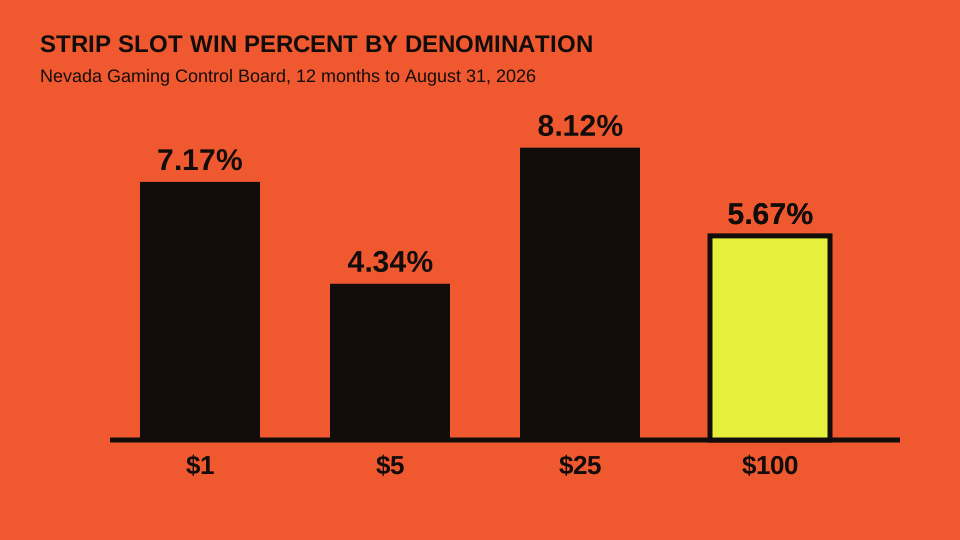
Not by rule. Nevada's regulator reports the casino's win share by denomination, and on the Las Vegas Strip it was 7.17 percent at $1, 8.12 percent at $25 and 5.67 percent at $100 over the twelve months to August 2026.
Last checked October 2026.
The short version and the catch
The question “do high limit slots pay better” gets a confident yes in plenty of places. The data that is actually public does not back it. A machine that costs $100 a spin does not carry a rule that it returns more, and the regulator’s own tables show a casino win share that goes up and down across denominations without following the price of the spin.
The catch is that this is not the whole picture either. The tables describe groups of machines, not the paytable in front of a player. The same limit applies to any claim about high limit slots rtp, since a return figure belongs to a game and a setting, not to a room. And people who ask are high limit slots worth it usually mean something else: whether the money is worth the entertainment. The arithmetic below speaks to that, not to a promise of better returns.
What Nevada publishes about win by denomination
The Nevada Gaming Control Board publishes a Monthly Revenue Report built from the statistics that nonrestricted licensees file. For slot machines it lists, by denomination, the number of locations, the number of units, the win amount (in thousands of dollars) and a column called Win Percent. The report defines that column for slots as the reported win divided by the total amount played by patrons.
The figures below come from the report for August 2026 (as of 09/21/2026), the Clark County Las Vegas Strip Area table for all nonrestricted locations, twelve months from 9/1/2025 to 8/31/2026. They are dated October 21, 2026.
| Strip slots, twelve months | Locations | Units (average) | Win, $ thousands | Win percent |
|---|---|---|---|---|
| 1 Dollar | 36 | 1,782 | 238,831 | 7.17 |
| 5 Dollars | 28 | 163 | 22,733 | 4.34 |
| 25 Dollars | 21 | 31 | 10,379 | 8.12 |
| 100 Dollars | 13 | 28 | 11,955 | 5.67 |
| Multi Denomination | 38 | 25,416 | 4,150,140 | 7.62 |
| All slot machines | 39 | 35,133 | 5,035,369 | 7.75 |
For Clark County as a whole over the same twelve months, the same report gives 6.48 percent at $1, 4.28 percent at $5, 8.28 percent at $25 and 5.79 percent at $100, with 7.42 percent across all slots.
Two things stand out. The order does not follow the denomination: the $25 group keeps the most and the $5 group the least. And the $25 and $100 groups are tiny, 31 and 28 machines on average spread over 21 and 13 licensed locations.
An earlier report shows the same wobble. In the Monthly Revenue Report for May 2026, the Strip twelve-month figures were 4.83 percent at $5, 7.23 percent at $25 and 5.74 percent at $100. The ranking held, the numbers moved.
Hold versus RTP, carefully
Hold and RTP look like two halves of the same number, and over a long run on one machine they are. In a regulator’s table they are something looser. So, do high limit slots pay better on that measure? The table says the answer moves around.
Hold is the casino’s win share of money wagered. It is measured after the fact, on a set of machines, over a stretch of time. RTP, return to player, is a property of one game’s math: the share of money wagered that the game is built to return over a very long run. A manufacturer sets it when the game is designed, and a venue may be able to choose among versions.
Subtract the Nevada win percent from 100 and the result is the blended share that came back to players on that group of machines. For $25 machines on the Strip, 100 minus 8.12 is 91.88 percent. Treat that as a description of last year, not a forecast. It blends different games, different paytables and different settings, and it counts money that was rewagered, because a credit won and played again is wagered again.
That last point is why the “amount played” in the denominator is far bigger than the amount that walked in the door. With the win and the percentage in hand, the implied amount played can be worked out: about $211 million for the $100 group over twelve months (11,955 thousand divided by 0.0567), which is roughly $20,600 per machine per day. The same arithmetic gives about $5,100 per machine per day for $1 machines. These are derived numbers, and they show how fast money cycles, not how much any person spent.
High limit slots RTP: why no rule appears
Looking for high limit slots RTP in a manufacturer’s pages is mostly a dead end. Aristocrat Gaming’s U.S. pages for Dragon Link, Lightning Link, Buffalo and Spooky Link, covered in the games guide, describe features and jackpot types and print no return figure. The regulator’s win percent is the nearest public number, and it is a blend.
What does move the return on a given machine is the paytable and the setting. The sources cited here do not say how versions are chosen or whether a venue can pick among them, which is itself the point: from the player’s side, the setting is not visible. Nothing in the cited sources says that the high limit room gets the looser versions, and nothing says it does not.
So the honest answer to whether high limit slots pay better is “not by rule.” A $25 machine on the Strip returned less than a $1 machine in aggregate last year. A $100 machine returned more. A $5 machine returned more still. A room is a place and a floor plan, not a setting.
Odds, volatility and what a spin costs
Odds on a slot are not the odds of a card game. Each spin is a random result, and the game’s math fixes how often each outcome comes up and how much it pays. A bigger bet changes what a spin costs. It does not change how a spin is decided.
Volatility is the other half. It describes how unevenly the return arrives. A high-volatility game returns the same long-run share as a low-volatility one but delivers it in rarer, larger pieces, so a session can end far from the average in either direction. Volatility ratings are not on the manufacturer pages, which means a player cannot tell from the outside which side of that line a cabinet sits.
Here is where the percentage misleads. A lower win share on a bigger bet can still cost more per spin. Using the Strip figures, the arithmetic is bet times win share:
| Bet per spin | Win share used | Expected cost per spin |
|---|---|---|
| $25 | 7.17 percent (the $1 group) | $1.79 |
| $25 | 8.12 percent (the $25 group) | $2.03 |
| $100 | 5.67 percent (the $100 group) | $5.67 |
The expected cost is an average across many spins, not what any one spin does. The cost per hour calculator turns it into an hourly figure from a bet and a pace.
Are high limit slots worth it?
Are high limit slots worth it? That is a question the data cannot answer, because worth is not a number in a regulator’s table. The numbers narrow it. A higher bet raises the expected cost of each spin in dollars. It does not buy a better return, and the regulator’s data shows no steady edge in either direction.
The popular belief that the answer to “do high limit slots pay better” is yes may owe more to atmosphere than to math. What a higher limit does change is the setting: a higher minimum and, at many casinos, a separate room. Those are reasons some people choose it. They are not payouts.
For anyone deciding whether it is worth it, a fixed loss limit set before the first spin matters more than the denomination. Help lines and tools are listed on the responsible gambling page, including the national line, 1-800-MY-RESET.
Reading the table without over-reading it
A few habits keep the table honest. Compare like with like: the Strip and Clark County rows cover different sets of locations, so the same denomination can read differently (the $1 group was 7.17 percent on the Strip and 6.48 percent countywide). Compare over the same period: a one-month figure for a group of 28 machines can look like a trend and be noise. And keep the unit straight: win percent is a share of money played, while win amount is dollars, and a group can have a low share and a large dollar figure at once, as the $1 machines do.
None of this makes the table useless. It is the only public, dated, regulator-sourced view of what machines in each denomination kept, and it is enough to retire the claim that a bigger denomination pays back more by rule.
How these figures were worked out
The win amounts, location counts and win percentages are copied from the Nevada Gaming Control Board’s Monthly Revenue Report for August 2026 (as of 09/21/2026), Clark County Las Vegas Strip Area, All Nonrestricted Locations, twelve-month column, and from the Clark County All Nonrestricted Locations table in the same report. The May 2026 figures come from the Monthly Revenue Report for May 2026. The report gives win amounts in thousands of dollars.
The derived numbers (blended payback as 100 minus win percent, implied amount played, amount per machine per day, expected cost per spin) are the author’s arithmetic on those published figures, rounded. Machine counts in the report are averages of units over the period.
What they do not show: they are not about one machine, one venue or one game. They blend all nonrestricted locations in the area. Groups with few machines swing from period to period (the $100 group read 3.69 percent over three months and 5.67 percent over twelve). Win percent counts rewagered credits. The report folds groups with fewer than three locations into “other”. Nothing here says a room, a casino or a denomination is looser or tighter.
Questions about do high limit slots pay better
Do high limit slots pay better than regular slots?
Not as a rule. Nevada's reported casino win on the Strip over the twelve months to August 2026 was 8.12 percent on $25 machines and 7.17 percent on $1 machines, so the higher denomination kept more, not less. A single machine's setting decides its return.
What is the RTP of high limit slots?
No single figure applies. Return to player belongs to one game's paytable and setting, and the Nevada report gives only a blended win share by denomination. Subtracting that share from 100 gives the blended payback, not a promise about any machine.
Are high limit slots worth it?
That depends on what a player wants from the session. Expected cost per spin is the bet multiplied by the casino's win share, so it rises with the bet even when the percentage is lower. Worth it is a question of budget and entertainment value.
Do you have better odds on a $100 slot machine?
The regulator's figures do not show that. On the Strip, $100 machines had a 5.67 percent win share over twelve months, lower than $25 machines at 8.12 percent, but the group is small and the share moves between periods.
What does hold mean on a slot machine?
Hold, called win percent in Nevada's report, is the amount the casino won divided by the total amount played by patrons. It describes a group of machines over a period. It is not a promise about the next spin on one machine.
Why does the win percentage change from month to month?
Because few machines and few locations sit in the high denominations. On the Strip, $100 machines showed 3.69 percent over three months and 5.67 percent over twelve, so a short period swings widely.
Is volatility the same as RTP?
No. RTP is the long-run share returned. Volatility describes how unevenly that return arrives: many small results or a few large ones. Two games with the same RTP can feel very different over one session.
Can a casino guarantee looser slots in the high limit room?
No source cited here says a room is set looser, and the regulator's data does not show it. A venue can say what it publishes, and any claim about a setting needs a source from the venue or the regulator.